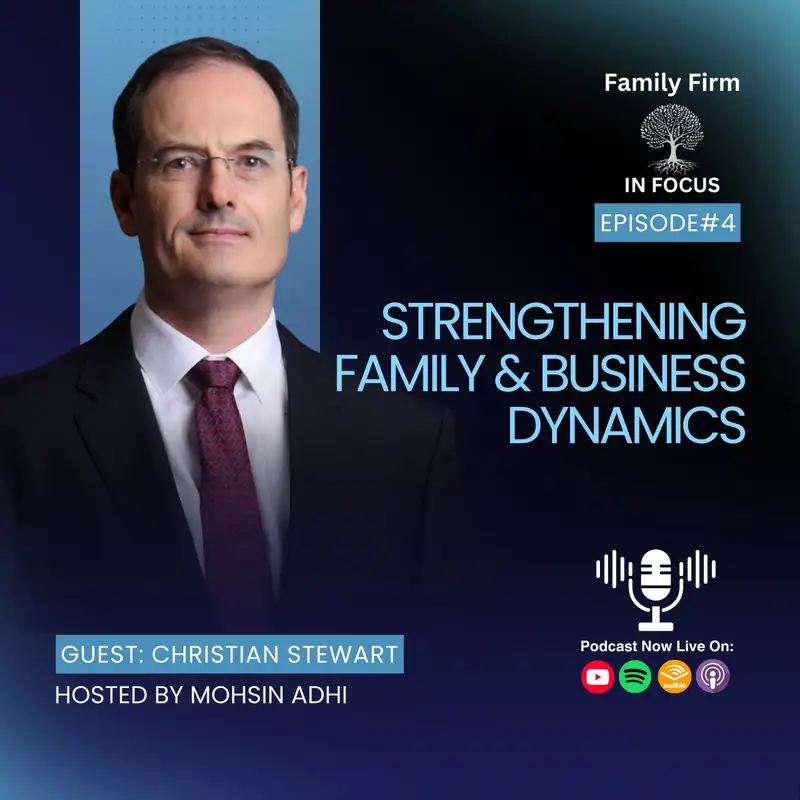
Strengthening Family & Business Dynamics | Christian Stewart
Hello, everyone.
Welcome again to our podcast, Family, Firm and
Focus.
I'm your host Mohsin Ebi.
And I am honoured today to welcome our
guest, respected Christian Stewart.
Welcome, Christian.
How are you?
Thank you very much, Mohsin, for having me.
And it's an honour to be here to
talk to you today.
So I'm really looking forward to this conversation
together.
Thank you.
Thank you, Christian.
Before we begin, although you're very popular, very
familiar, so many people around the world, those
who know you, those who have been into
the family firm space, they know you as
a very recognised advisor.
So I just want to briefly give some
introduction, although it's huge, I'm just going to
point out a few of the things.
Christian is a founder of Family Legacy Asia,
which was founded way back in 2008.
Christian is being awarded as an Interdisciplinary Award
by Family Firm Institute in 2000, if I'm
not wrong, 2021 Interdisciplinary Award.
21, yes.
And he's being recognised as the leading advisor
by Wealth Briefing Asia as well in 2017.
Christian is also teaching, co-teaching the module
of family governance and family governance model is
being taught by himself.
And it's an MS based programme in family
office and family businesses that's part of Hong
Kong University.
Oh, Hong Kong University of Science and Technology.
Hong Kong University of Science and Technology.
Christian has been privileged to have clients most
in part of Far East Asia, Hong Kong,
Singapore, Australia, Malaysia, Philippines, Indonesia and a few
others.
He has also got exposure in some of
the research based task in USA as well.
Yes.
He serves as a board of director with
the great Jay Hughes and for his foundation,
Jay Hughes Foundation, and he has been serving
there for about, I think, since inception or
how many years, Christian?
For a couple of years.
You've got me there.
I'm not sure.
So not since inception.
Maybe three or four years.
Great.
So Christian, before any further delay, let's begin
with some of the questions I was going
through your profile as well.
And the purpose behind this family focus is
that since I'm also part of Family Farm
Institute and we all advisors join together, we
learn from each other.
So from the perspective of Asia, we can
see and from people coming from West as
well as advisors, those who have got exposure
and there are a few questions which I'm
going to place and we can start a
conversation accordingly.
Regarding the interdisciplinary rules, which we can see
within the team of advisors, can you please
shed some light on this interdisciplinary rule from
the perspective of Asia, which is different as
compared to other part of the world, because
the cultural things are different.
There are some different legacies aligned to this
and you are much more aware of that.
What do you think about?
Yes.
Yeah.
So maybe there's two parts to answering that
question.
Maybe the first part is to tell you
what I think is an ideal working arrangement
as a consultant to a family.
Then I have to maybe think about what
does this mean in practice?
Is it easy to actually implement in practice?
So the first part is my concept of
the ideal.
So vast majority of my client base have
been overseas Chinese families.
I've had one engagement for six or seven
years with an Australian family, so a Western
family.
So that's really my counterpoint.
But to me, I come from a structuring
background.
I was originally a trust lawyer.
Then I moved into governance and it was
only since about 2016-17 that I've started
to get exposure to learning and development through
having clients that had coaches that were working
with them.
But I think about family governance or governance
for family business, and this is often said,
there's always a structural element to it and
there's a relational or culture element to it.
I've realized, almost by accident, by being sort
of forced by my clients to work with
people who are good on the relationships, good
on the culture, good on the coaching and
development side, that where your discipline of origin
is something like law, you're never really going
to be very good at the relationship piece
of it.
So it's almost quite obvious, but I think
governance work, whether it's family business or family
of wealth, it really requires an interdisciplinary team,
which is different from multidisciplinary.
And it's obvious, you need somebody who has
that sort of structural vision for the family,
someone who can help guide them, but as
a consultant, not as an expert, towards whatever
is the next step they need to take
on the governance side.
But the governance doesn't work unless it's aligned
with, or supported by the culture.
And so therefore you need a culture person,
and it could just be as simple as
a coach working together.
So to me, that's the ideal basic team,
and it is more of an interdisciplinary team.
So let me also come back to that.
However, you kind of need both to go
together, because the structural person or the governance
person needs to have an appreciation of and
support the work that's being done by the
culture person.
And I often say there can often be
a push and pull between those two sort
of advisory approaches.
And the culture person, so again, it could
just be a coach that I'm talking about,
they have to have experience or understand the
context of, we're working with a family business,
right?
So there may be two things about that.
One is, you don't want the coach, and
you hear this story a couple of times,
you don't want the coach to come in
and tell the family member and say, well,
it would be healthiest for you to individuate
and just leave your family.
That's kind of not the context.
The context is trying to figure out how
we get both together.
And that culture person or that coaching person,
they have to understand that there are different
roles, and they have to understand the role
context of the different individual family members.
Anyway, so that's the basic team.
But then in my approach, and this is
sort of very, but then there's two extra,
and they're off to the side.
And so what I learned from Jay Hughes
is it's really important to help grow the
human, intellectual, social, spiritual capital of the family.
And a big part of that is helping
the individual family members to know themselves.
And in practical terms, that means introducing different
assessments to the individual family members.
And so, for example, like the starting point
for me often, it would be a neogram
assessment.
So if I'm working with a sibling group
of like three or four siblings, I will
often, so ideally, it's myself and somebody who's
better on the relational side as a team.
And I'll introduce each of the siblings and
maybe their spouses to another coach or expert
who can do the enneagram assessment or do
another really good assessment is called the Pro
D assessment, which is sort of very good
vocation.
So there'll be people that I bring into
the assessments.
And I'll just finish up on this piece.
So again, the philosophy is like, how do
we grow the human capital of the family?
Well, you help the individual family members to
know themselves, so increase in self-knowledge.
So there's sort of a list of areas
that you can explore with individuals.
But then there's another side to the coin.
So this is my perfect engagement, ideal engagement,
if I have a magic wand.
The other side to the coin is that
we all have things that hold us back.
We all have limiting beliefs.
We all have, and a lot of the
things that hold us back, you know, we
think about them, but often they're unconscious and
often they're embodied.
So where I can, I will encourage, so
if I'm working with a sibling group of
like three or four different siblings, I will
encourage them to go and also do their
own sort of personal work with a somatic
healer that I like to work with.
Do it online, and they sort of do
one-on-one calls with this somatic healer.
And to me, that's like the perfect combination
for how you can help grow human capital,
basically, or kickstart that off.
So then if you sort of sit back
and think about it, and this can lead
into this idea of a chief learning officer,
is I guess you say like the basic
philosophy is that the growth of the human
capital, so the individual development in a family
business or family of wealth is important.
The getting better at collaborating together as a
team in a family business or family of
wealth is important.
So this development aspect is really important.
So to me, you cannot separate learning and
development from family governance.
Like the two have to go together, because
it's usually about how can we get the
family to be more effective together, as a
family and at the ownership level.
And to do that, therefore, again, you need
this sort of team where you can balance
structure and culture in the consulting.
And you need to be able to source
experts who can help family members with different
issues.
Like another quick obvious example might be, you
know, where you're dealing with significant inherited financial
capital, there could be like psychological issues around
the money.
So maybe you have to introduce like a
therapist who specializes in money issues, or a
consultant who can help with couples relationships.
So I think, yeah, so there's this idea
that you are the consultant, but you also
need to be a conductor and bring in
different kinds of specialists.
Sorry, that's a lot.
Yeah.
That's really a great point.
Especially when we talk as an advisor, you
have highlighted that is important need that, first
of all, the family has to be aligned
with the top tier of the main key
person of an advisor.
And then advisor has to get the team
aligned where it is required.
It could be with respect to the relationship
therapy could be relationship wealth therapy, they could
be and especially considering from the background and
from the country areas where we are coming
from.
There is a requirement of women.
My next question is also putting into the
women as well.
Women are getting more and more engaged now.
And it's really very important that they feel
more comfortable with the same gender of advisor
at times, coming from again, considering Muslim culture
and the culture where especially I belong to
Pakistan or such things.
So women are getting involved now.
They are getting education, they are getting into
the business, they're getting more and more involved
in family businesses, as they are getting more
awareness and idea for the rights, how to
protect the rights, how to get into the
business, be aware of what's going on, what's
happening, what could be the inheritance law and
all such things.
So what's your takeaway with respect to this?
Do you think, I agree with this, that
yes, women are getting more involved and awareness
is increasing?
Yeah.
There's a couple of points around this.
But maybe I'll just, I will.
So again, most of my clients have been
overseas, ethnic Chinese.
I have to say that the most powerful
person I've ever dealt with is a woman
who leads her sibling partnerships, leads the sibling
partnership, and was always the natural leader within
the family.
And there's something about, if you have all
male sibling partnerships, they can be pretty rowdy.
So it's almost like a strength for the
family.
If you have a couple of daughters in
the family, it's a strength because the sibling
groups with females are better functioning.
But with the overseas Chinese families, they have
a traditional inheritance rule.
So I've been in Hong Kong for 30
years, and I think I've seen it change
over that time.
And it's called the Equal Inheritance Rule.
And it was a principle that, so the
overseas Chinese families can be very hierarchical.
So you have a patriarch, you can have
a matriarch in a sibling group.
The siblings are usually very hierarchical as well,
though there's a lot of variation around that.
But the Equal Inheritance Rule is that if
you have four siblings and three are males,
then traditionally it meant that all three males
got an equal inheritance, equal ownership of the
shares in the family business.
And traditionally, the daughters didn't.
And then I think over my time, you've
seen the daughters starting to get part shares
was kind of the first step in the
family business, maybe half the share that each
of the sons get.
Whereas today, I think it's very much a
case of equal ownership.
So today, I see daughters in the overseas
Chinese families having equal ownership rights to the
sons.
I guess the way I'm thinking about it
is, but you still might see the daughters
being assigned, the sons are in the business
or operations, and the son and the daughters
are running the family office or running the
family foundations on the same task.
Yes.
So definitely women have the right to be
at the table with the overseas Chinese families
today.
So think about the four-room model as
a family business consultant.
So any family business, we have a family
room, we have an owner room, we have
a boardroom, we have management.
And the thing about that model is to
say that, well, actually all four of these
rooms are important.
And we have to look at the functioning
or effectiveness of all four of these rooms.
And the model tells you that succession for
a family business is about, it's not just
about the management succession, which is the way
the older generation tends to think.
So how can we get the right people?
There's multiple opportunities to participate in the succession.
So the female family members, of course, they'll
have a role in the family room, as
I said, maybe family office, family foundation is
a common scenario.
But the key room that is underdeveloped with
the ethnic Chinese families, overseas Chinese families is
the ownership room.
And so it might be that you can
have one or two of the sons in
management roles.
And in a lot of families to start
with, if they haven't looked at their family
governance or family business governance, they don't think
about the ownership role.
And they don't think about accountability to the
owners.
And the ownership is actually more important for
the business continuity than the management role.
So to me, it's maybe that's the key
thing to me as a consultant is let's
build up the ownership room and let's work
out what are the decisions that have to
be approved by the ownership room or made
by the ownership room.
And so even if the daughters are not
in the management role, today with the equal
inheritance rule, they're in the ownership room.
So that's where the family have to learn
to have this accountability and equal voice to
daughters as part of that ownership room.
I have another client family where if you
look at the third generation, it's the daughters
who all the, it's the daughters, girls, cousins,
female cousins, who are the smart ones in
that family.
So it's definitely changed for the time I've
been in Hong Kong.
What happens if there are no son and
only let's say a person having only daughters?
And how usually the Chinese family do the
inheritance in that case?
There are examples in Hong Kong.
So as I started with, I've seen this
one family where the most powerful figure is
the daughter.
There are Hong Kong families, I haven't worked
with them where it is only daughters.
Then they inherit, they operate it, they run
it.
If there are no sons, that's it.
There is a very famous old Hong Kong
shipping family, which is going back before my
time, where the patriarch was quite famous for
having four daughters.
In that particular case, I think he split
the empire into four different, if anybody's listening
to this and they're from Hong Kong, they'll
know what family I'm talking about.
He split the empire into four shares, divided
it one for each of the four family
branches, but effectively the sons-in-law then
took over the management role in that particular
case.
So that's an old Hong Kong example.
So lots of variety.
In fact, this leads to another debate, but
that's not a part of this, but there
are certain constraints where people think that there
should not be any in-laws involving in
this.
There are some families, those who said that
no in-laws policies as well.
Yes, yes.
So when I talk to my friends, colleagues
in the US, in-laws definitely have a
full seat at the table, definitely in the
family governance.
When I look at this Australian family, a
Western family that I had worked for, it
was still a bit mixed.
There were some governance activities which were only
for the male sons, but generally a lot
of participation by the predominantly female in-laws
in that case in other governance forums.
So I noticed with the clients that I
work with, if they're ethnic Chinese families, then
if you say who should come to the
family meeting, a family council or an owner's
council, no, they don't include the in-laws.
It's more normal that they will not include
in-laws in the family governance except to
say, maybe once a year we're going to
have a family, once or twice a year
we'll have a family assembly meeting.
But the family assembly will largely be for
social purposes.
It won't have any real teeth or voting.
So I do try as a consultant to
figure out ways to get the in-laws
included in a family meeting, for example.
So I worked for six years with one
family where there are three siblings, all sons,
all working in executive roles.
We would typically see them for a two
-day family meeting to work on part of
their family constitutions or family policies or communication.
Lunch on the second day.
So we would often have dinner with the
whole family the first night or the second
night.
Lunch on the second day, we always brought
in their spouses and later on would spend
the second day afternoon doing some kind of
mini workshop on a topic that was good
and fun for their relationships, which included the
sons and their wives, and then bring in
the parents at the very end of the
day for a wrap-up.
So it was a safe way to let
them know we're having family meetings, to include
them in some kind of activity part of
the family meetings, and eventually to give them
a high-level briefing of what had been
agreed on in the family meetings.
But they weren't given a full seat at
the table for the whole duration of the
meetings.
Great.
And Christian, your specialty is facilitated communication among
the family members.
And while structuring the whole governance structure, it
plays a very important role when you are
dealing with them.
You're setting up the meeting, you're setting up
the family council.
How crucial it is, especially for the families,
those who are listening, how crucial it is
to set up this important role of communication
among the family members and among the advisors
and the families, those who are members as
well.
Yes.
Maybe I'm thinking there's three sort of parts
or points to this.
But the first point, and this was an
old rule of thumb or principle I was
taught or heard from a family business consultant
many, many years back, which was that in
certain parts of Asia, there was a lot
of interest in the family constitution.
I remember listening to this very experienced advisor
at the time saying, if you can't listen
to each other with empathy, you can't have
a family constitution.
And I think that's a really good principle.
So to me, the whole purpose of family
meetings is to have a place where the
family can have better communication than normal.
That's the starting point.
So if you are starting a governance assignment
with a family, I think the first step
is to think about how can we make
communication in the family explicit.
So getting the family members to do a
survey that sort of rates how effective they
are at communicating is probably a very good
starting point when you're in an assessment process
or phase with working with a family.
And that could be pen and paper, or
it could be online.
There's this thing called the circumplex model, which
has an aspect of family communication and family
flexibility.
So making that topic of communication explicit is
important.
If you are working with a family, then
you're likely to have them help put in
place family meeting rules, asking them to reflect
on what does good communication mean.
And then discuss that based on their own
experience and codify it.
But then I guess there's a question of,
okay, when you're a consultant or facilitator working
with a family, facilitating a family meeting, using
that as a forum for improving communication is
good.
But then the next question is, okay, what
about when you're not around anymore?
What does the family do when they don't
have a facilitator present?
So when the facilitator is present, I can
answer that because that's easier.
One thing is, I like to do my
family meetings using the philosophy or the structure
of a lady called Nancy Klein.
Her first book is called Time to Think.
She wrote another book called More Time to
Think, and I think she has another one
after that.
And she's well known for this idea of
the thinking environment and thinking pairs and partnerships.
So she recommends practices like starting meetings with
a round where everybody just has a chance
to become present and download what's on their
mind, and finishing meetings with a round of
gratitude and some great gratefulness for what's happened
in the meeting.
So I like to bring in her principles
of thinking rules.
I like to set up things like have
a row of chairs in a line so
they're not facing each other, put everybody in
the chairs, and one person can speak at
a time without interruption from the others.
And so when you're dealing with a hierarchical
family, I've had cases where the youngest son
has said to me,