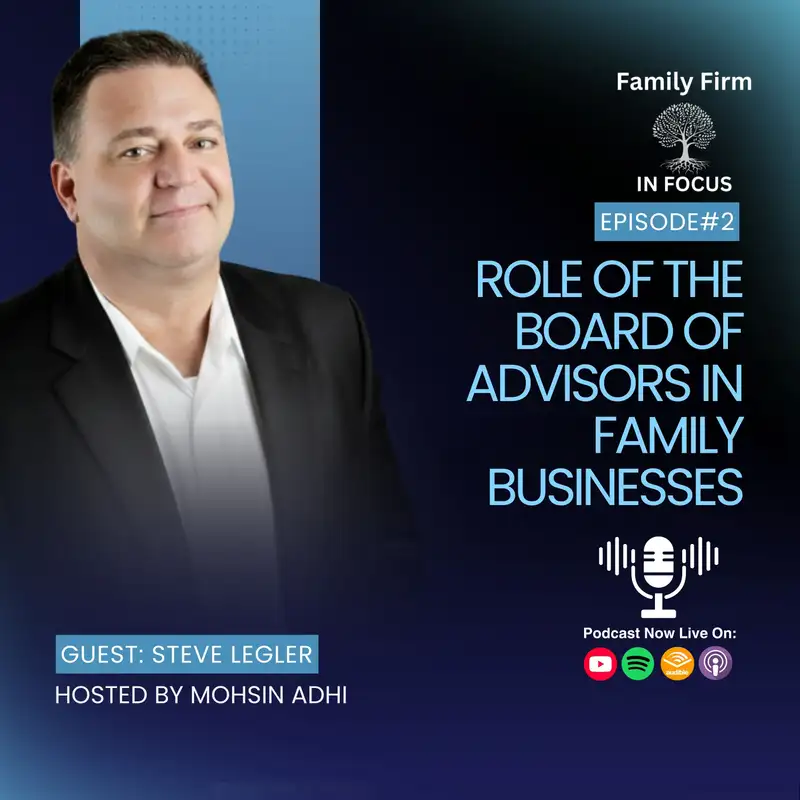
Role of the Board of Advisors in Family Businesses
Hello everyone, welcome to the new episode of
family firm in focus, where we discuss with
advisors, with family businesses, different aspects of family
businesses, what could be the learning aspects and
the main vision behind this platform is to
facilitate family businesses and the advisors, those who
are facilitating family businesses.
So today my guest is very senior advisor,
my mentor, he is an author as well,
he is host as well, and most of
the times he is also being serving as
a guest as well, like in our case
today, and he is continuously contributing to his
writing.
Along with that, he is a faculty member
of FFI, the leading institute of family business
advisors and FEA, which is the family enterprise
exchange Canada.
Along with that, he is a coach as
well, and most importantly, he is coming from
second generation family business.
So I would like to welcome Steve, warm
welcome to you Steve, thanks a lot for
your time.
Thank you, I'm honoured to be here with
you and look forward to our discussion.
Great, wonderful.
So Steve, first question, coming from a second
generation family business background yourself, how does it
contribute to your advisory practices?
Yeah, that's a really good question, because I
know a lot of people who do this
kind of work who were not lucky enough
to have grown up in a family where
they were part of this.
And it's hard for me to, you know,
hold that against them.
So some people manage to do this work
really well, despite the fact that they haven't
grown up in this.
But I would say I've never done the
numbers, but probably half or so of all
the advisors that I know that do this
kind of work with families have some kind
of lived experience.
Either they were actually working in their family's
business, or there was one earlier on of
their ancestors.
There's often people are attracted to this work,
because something went wrong in the transition of
a family business somewhere in their family tree.
And they're curious about that.
Like, oh, I got into this because my
mother got, you know, written out of the
family business that her brother ended up taking
over.
And so people come to this work from
a number of different backgrounds.
Some of them, it's just some professional training.
I, you know, I was trained in the
business circle stuff to learn to take over
my dad's business.
And then we sold that when I was
still in my 20s.
And it was only much later that I
discovered this world of serving families with these
transition challenges that I realized that my lived
experience of what I grew up with, plus
I married into a business family as well.
And I saw how my in-laws handled
the transition of the business.
And they had a liquidity event as well
and how they handled that.
And learned from a couple of different examples.
And it always serves me well.
And I have to make sure that I
never commit the error of assuming that, well,
my family was like this.
So therefore all families are like this because
there's no family that's like mine and there's
no two families that are the same.
So every time people like me walk into
a family situation, we're always starting with a
clean slate and trying to figure out who
all the players are and how they relate
to each other so that we can help
them with the challenges of transitioning a business
from one generation to the next.
Even though we are coming from second generation
or third generation family business and serving as
an advisor and in the capacity of advisor,
we cannot say that every experience is going
to be same.
So we have to be really clearly focused
on that.
Keep ourselves open, how to advise.
That's a good offer out of this.
Moving on, we have seen, like including myself
and when we go through various conferences and
workshops, there is a question being highlighted that
those who are founders, those who are entrepreneurs
themselves, they have taken up the risk.
They know the business well.
They know the fundamentals behind the sector in
which they are working.
Then they come up with the question, we
are so senior, we have so much experience.
Why should we take on board any advisor
who is coming out of the family and
what kind of help we are going to
get out of it?
What do you think about it?
So you're bringing me back to my father
and the way he was with respect to
advisors and he joined a group called CAFE
back in the 80s, the Canadian Association of
Family Enterprises.
He said, you know, we go to these
meetings and people say things that these experts
come.
Now, these experts, I didn't realize at the
time that I was going to be one
of these experts someday, but they said stuff
like, you shouldn't hire your children right out
of school.
You should get them to go and work
somewhere else first, but we're not going to
do that.
So he didn't listen to those advisors.
Then he heard them say, you should have
family meetings and you should have an outside
person come and facilitate those family meetings.
Well, he called a family meeting, decided he
didn't need the part about having an outsider
facilitate.
We had a family meeting.
We went away for a weekend in 1985.
The next family meeting didn't happen until 2006.
So if you're doing the math, that's 21
years later.
That is not the recommended interval between family
meetings.
And we only had that other one because
he was diagnosed with cancer and felt like,
oh boy, we have to have a family
meeting.
So advisors that come from outside, I understand
the reluctance of the all-knowing entrepreneur who
founded the business, who knows the business.
What I suggest is that those founders, yes,
they are experts in the business, but this
is more about, I intervene more with the
family and how the family relates to the
business.
And another mistake they often make is, okay,
well, we'll bring someone in to deal with
us, but only with the people who are
working in the business.
So if there are three children and only
one is in the business, the founder will
say, no, just deal with the ones in
the business.
And it's all the stuff of the family
members that are not part of the business,
where often there are problems.
And so my attitude is when I deal
with family, I deal with the whole family,
whether or not they are employees in the
business, they are stakeholders, they may be future
owners, they need to be involved in the
discussions about the business.
And you have contributed a lot in a
term called professionalizing family business.
I was going through one of your resource,
which has a video as well, and that's
a written article as well.
So your video explains there are five different
ways to professionalize family business.
And at the third point I stopped and
I was going through that terminology, which says
upgrade your advisors.
It's not that upgrading your employees or your
board of directors, it's upgrade your advisors.
Can you please shed some light on this
point?
Yeah.
So what happens a lot is that an
entrepreneur will start a business and they'll have
an accountant, they'll have a lawyer, they'll have
someone that helps them get started when they
have a very small business, but they become
friends with these advisors.
And then fast forward 10 or 20 years,
the business sometimes has grown enormously and the
needs of the business of what that business
needs.
Now, when it started with three employees, and
now it's 300 employees, the challenges that that
business faces are usually a lot different.
And oftentimes that accountant or lawyer or whoever
was dealing with smaller businesses is not equipped
with the education, with the connections, with a
large enough firm to deliver all the services
that the family needs.
So sometimes it's really hard because they become
friends with these people.
And it's not about, well, I have to
fire you, buddy.
It's like if you need a lawyer for
more specialized things, ideally you should be able
to reach out and find people that can
advise you at the level that you need
it based on where the business has grown.
Because too often what happens is these key
advisors that become dad's buddy, and now he
just relies on those same people he's been
relying on and there's no fresh thinking and
they don't necessarily have what it takes to
advise the family and the business to get
to the next level.
And so that can sometimes hold the business
back.
For example, digitalization or getting on board the
artificial intelligence system, you need to have upgraded
lawyers or upgraded people, those who can learn
about the intellectual property.
They can protect your intellectual asset as well.
So this kind of example could be.
Again, referring to the same video or the
article as well, it also highlights the importance
of creating board of advisors.
That means you are asking family businesses to
have different people coming off from different disciplines
and creating a board for advising.
How does it work for families?
Well, so what often happens is when a
business grows to a certain size, they will
start talking about having a board of directors.
So a fiduciary board of directors that have
full responsibility to guide the company.
Most smaller family businesses as they grow, that
leaping to a board of directors with fiduciary
responsibility is kind of too big of a
leap for most of them to take.
So what often happens is people like me
will say, why don't you start with a
board of advisors?
Those advisors, they're people from outside the business.
They come to meetings, quarterly meetings, usually they
get paid for coming.
They're not just dad's golf buddy and his
accountant from 30 years ago.
It's you actually go and find people who
have experience in a related industry or people
who have a business of a similar size
or stage.
And you can bring people around to have
other people besides what typically happens is it's
dad and it's the two, the two next
gens.
And they are trying to decide things as
a small group.
And often there is tension between the generations
of a family and to have outside people
with an independent perspective is a very good
thing.
So for example, when I came back to
my family business with my MBA, my dad
was, well, I'm not going to have a
board of directors, but all of a sudden,
as he moved up to chairman and had
hired an outside president, the idea of having
a board of advisors and having other people
supervising me as I was coming into a
role to eventually take over, that was actually
appealing to him because he would still be
in control, but he would have other voices
at the table to help to mediate some
discussions about the future of the business, but
hopefully good qualified people that actually have something
to add to help the business.
Wonderful.
So when we look at this and you
have written that this is one of the
single most, I would say biggest step to
professionalize, is there any reluctance in going ahead
with this step?
Like it does belong to founders?
There's always reluctance.
I think one way to overcome that is
to do it in small steps.
So if an ideal board of advisors would
have, you know, four or five outside advisors,
you don't necessarily want to start with trying
to assemble four or five.
I would suggest starting with two.
I wouldn't want one because then that's just,
it doesn't feel the same.
But I would, if I were working with
a family that said, let's start this, I
would say, let's identify two people and let's
sort of beta test what meetings would look
like and what an agenda would look like
to get everyone used to the fact of
what's going on.
And then assuming that goes well, start to
add, okay, so what other profile of what
type of a person would we also want
to add and where can we find such
people?
So that let's say that full board of
advisors with four or five outsiders, that might
be in place maybe two or three years
later.
That's how I would probably recommend someone do
it.
And if you start them, if you choose
the first couple well, that so things things
go in a way that the founder likes,
the chances are that continuing will be something
that happens.
If it doesn't go well, then they're probably
going to kibosh the whole thing.
That's a big challenge when it doesn't go
well, then there could be more reluctance coming
out of it.
Yes.
Yes.
It's the same thing with when, you know,
sometimes I meet with a family and they
tell me what their story.
And I say, you know, you should, you're
going to have to have a family meeting
to discuss this.
And just those two words, family meetings sometimes
scare them because, you know, they had a
family meeting two years ago, five years ago,
10 years ago, and something didn't go well.
And now they've been scared of even trying
to have a family meeting.
The same thing could happen with having an
advisory board.
Oh, we tried that.
It didn't work.
We're not going to do that.
Well, perhaps you tried it in a way
that was a little bit clumsy and didn't
work out.
And maybe we could, you know, plan it
a little bit better and do it in
a way that has a higher likelihood of
success.
Yeah.
Coming from the same question, when these board
of advisors are being, they are hired, if
I'm not right.
So they are not taken on board as
the independent board of directors, just to attend
a meeting and you will be paid for
the meeting.
They will be hired as an employee.
Is it correct?
No, it's not.
It's not an employee.
It's a professional relationship in the same way
that you would hire an accountant or a
lawyer or someone else, but it's important that
it be paid.
So often people think, well, I'll just get
some of my buddies come, they'll do it
as a favor.
And when it's not paid, it's not taken
seriously enough and it doesn't have the gravitas
that you want this board of advisors to
have.
Ultimately, you want this board of advisors to
be a group of people that all the
key employees in the company are respecting and
listening to and wanting to get their input
on.
So I always suggest to aim a little
bit higher in who you're trying to get
and be willing to pay the people a
quarterly amount for coming to the meetings.
But they're not employees, but they're paid.
They need to be paid to show up
so that it is taken seriously by them
and by everyone else around them.
Because if you just had, oh, here's some
volunteers, some of dad's friends are coming and
they're going to sit around one evening and
talk about the business.
It doesn't have what it needs to be
taken seriously.
And it's an important enough step that it
makes sense to do it that way and
do it right or not do it at
all.
It's not going to add any value.
You're not going to make it a part
of a compensation.
Yes, you're going to get out of it
what you put into it.
And if you choose not to put enough
into it, you're not going to get enough
out of it.
You have mentored numerous advisors, including myself as
well.
How would you advise that advisors should upgrade
themselves?
What is the key role of advisors considering
the fact that we are discussing the role
of advisors in the family?
So how would they should upgrade themselves?
So I've had this question a lot over
the years.
And I don't like to be too directive
of telling people you must do this or
you should do that.
But I can tell you what I did.
And so I did this program, FEA Family
Enterprise Advisor in 2013.
And that's where I discovered this world of
advising families on their business and wealth transitions.
And the first thing I said was, oh,
okay, this is big.
I think I want to do this, but
I don't know that I have the skills
to do this because I was trained.
I have an MBA.
I have a CFA, Chartered Financial Analyst.
I have all the things from the business
circle, but now I was moving into what
I call the family circle.
And I wasn't convinced that I was well
-equipped enough for that.
So I remember saying on the first day
of that Family Enterprise Advisor program, wow, I'm
going to have to do some more training
and conflict resolution skills.
And then somebody said, yes, and coaching.
And so that got me down the road
of taking coaching courses.
And that was the biggest game changer for
me because coaching, the biggest thing about coaching
is learning how to listen without judgment.
And that is so important, the listening skills
that you need.
So many advisors come from the technical side
as accountants or lawyers and what I call
STEM.
And now they're moving over into an area
where it's more liberal arts.
It's more about the way you are and
the way you communicate with people and how
you listen to them.
And do you have empathy and are you
able to, do you have the emotional intelligence
to sit in a room of family members,
which I am often doing where they're all
family members and I'm the only outsider who's
not part of the family and learning to
be able to sit in that room and
add value and facilitate a conversation is not,
they don't teach you that in accounting school
or banker school, right?
So there are things.
So I did coaching courses, facilitation courses.
I started learning about family systems theory.
I really immersed myself because I want to
do this job well and you never stop
learning.
And the best practice though, is to be
in there in the room with families, but
you have to show up in the right
way.
If you come in to a family meeting
with, Oh, I'm going to tell them what
to do.
It doesn't always work so well.
It's more about being with the family and
helping them figure their own stuff out and
making sure that they listen to all the
voices in the room, which is not the
same skillset as what many people trained in
that get them attracted to this work.
So that shift into the more social part
of it, the more relationships, the emotional part,
it takes some work.
Some people come at it very easily and
others, it's a lot more difficult to learn.
But what I did learn about myself, and
I only realized that a few years ago,
my dad was a great entrepreneur and he
could not do what I do because his
attitude was, he knew what to do and
he'd tell you what to do.
And that worked for him in his business.
But what works for me to be able
to sit with the family and listen to
people are all the traits I actually got
from my mother and my mother's side of
the family to be able to sit with
people and listen to them and respect them
and try and draw them out and work
on coming to solutions together.
So I was lucky that I had a
mother that I inherited some of this from
and allows me to do this well.
I am imagining that family is sitting in
a room and an outsider advisor, like you
mentioned yourself is there.
So it must be a challenging task, right?
That everyone has to speak and everyone is
expecting that the advisor, the person who is
actually moderating the whole session, the family meeting
or something will listen, right?
So what kind of situation would that be?
I've been in some really interesting situations where
people start screaming at each other and people
start swearing at each other.
And sometimes it's really challenging to not overreact.
So I have an expression that I like
is it's counterintuitive, but it's don't just do
something, sit there, which is the opposite of
what you normally hear at sometimes the tendency
to overreact.
But for me, and I actually had this
happen in a meeting just a few weeks
ago where it got heated between a rising
gen and a parent and it needed to
emerge, it needed to be said.
And so I had to let it happen.
But then the trick is how do you
now put the pieces back together and get
the meeting back on the rails and still
continue to do what you were there to
do?
And some people are very uncomfortable.
I've heard stories about people who walk into
a family and they're from a culture where
people yell at each other all the time.
And if that advisor is not comfortable with
that, they might immediately think, oh my God,
this is the end of the world.
But really that's just how this family deals
with each other.
So understanding what's normal for the family takes
a little while, but you need to be
prepared for things that, you know, I always
say, I walk into a room, I don't
know what's going to happen, but I trust
myself.
And some people describe it as a skill
that's like surfing.
Like I'm confident on the I don't know
what wave is coming, but I know I
have confidence in myself to be able to
navigate it.
Now it's not always perfect and sometimes a
really big wave comes and knocks you off
the surfboard and then you get back on
and hopefully you can still keep riding it.
But it's really interesting work and it's not
for everybody.
So I advise people who take the FEA
program, I'm a project team advisor.
They go, they get put in a team,
all the people in the cohort, and they
have to go find a family and do
a project.
So a couple of years ago, I advised
the team and when the project was over,
one of the people on the team said,
I'm so glad I did this, I'm never
going to do another family meeting again.
I learned that this is not for me.
And I said, bravo, congratulations, because I much
prefer the people who recognize, I don't want
to do this, compared to some people who
say, oh, this is easy, I'm going to
go and I'm going to start to do
this.
And if you're really not well trained, you
can actually go into a family and not
do damage, but really not help them.
And so I hesitate to get people to
say, yeah, just bring anyone in to come
and facilitate your family meeting, find out if
the person has experience and knows what they're
doing first.
Oh, Steve, getting to my culture background, where
I come from, we cannot say anything in
front of our elders, right?
And perceiving myself conducting this kind of meeting,
and after the meeting, the younger generation comes
to me and say that, sir, it was
not possible to say something against my elders,
but I have a different point of view.
How will you deal with such a situation?
That is a challenge.
And I was on a webinar once in,
I believe it was the Philippines.
And what happened was, and the person who
invited me said, there are families out there,
and where the parents with two generations are
watching the webinar together.
But the way they dealt with questions was
you could text your questions into the moderator,
and then the moderator would ask the question
of me and the other guest.
And it's because it's, I understand, yeah, it's
really hard.
It's an extra challenge.
It really is.
And all I can say is, when I
started this work, I really thought that the
bulk of the work would happen when I'm
in the room with the whole family.
And what I realized after doing this for
over a decade, that's part of the work.
It's an important part.
But the one-on-ones that I do
with each family member in between those meetings,
or the extra meetings that I do with
the parents to help them hear some of
the messages that I'm hearing from their rising
gen, but not saying it with the rising
gen in the room, or the meetings that
I have with just the rising gen without
the parents, so they can feel open with
me, then my role is sharing information in
a way that's neutral and in a way
people can hear each other.
And sometimes I'm the one delivering part of
the message, because people don't feel they have
a voice.
But I always try to get the people
to voice things themselves.
And I also have to be sensitive to
the culture where that is a real huge
burden to come out and say something that
appears to be against the parents.
So there's so much work that happens between
the family meetings.
And that's where a lot of the progress
happens.
And it's getting both generations to trust me
enough to share with me and to listen
to me.
Wonderful learning experience which you are sharing, Steve.
Thanks for that.
Getting to the conclusion, Steve, I was going
through your website and in the last there
is a statement written, stop working in your
family business and start working on your business
family.
That is the secondary title of my first
book, Shift Your Family Business.
And I thought I was being clever, and
I still think I am, because it really
highlights two things.
One of them is there's this whole thing
about people that are so busy working in
their business that they're not working on it.
And so often that's founders.
They're so busy playing a key role.
And it's only when they realize they need
to leave those roles to people so they
can get out and work on the business
rather than doing the nuts and bolts of
what the business is doing.
So that's a well-known thing from books
from decades ago where they talked about working
in the business, working on the business.
But then the other thing that really struck
me is just the difference between, is it
a family business where the noun is the
business and the business happens to be owned
by the family?
Or are we talking about the business family?
Are we talking about a family and the
important part of the family?
And so what I wanted to encourage people
to do, and I still do, is stop
thinking about the business first, think about the
family first.
There comes a point in time often in
the founder's life where the business has grown
to a certain size.
And now I think that some of those
founders should shift their focus and stop thinking
about the business.